

Dr. Moti Medina Develops the Processors of the Future
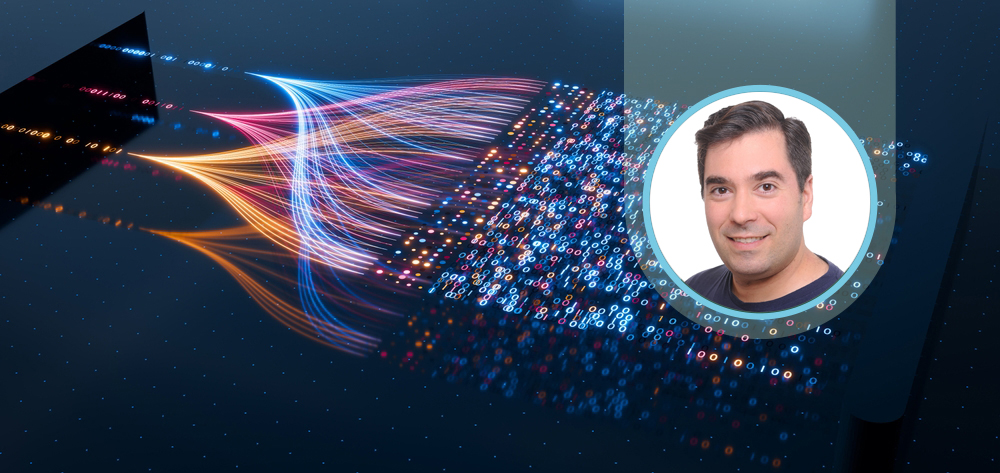
In his lab, Dr. Medina integrates problem abstractions, algorithms, and hardware in an attempt to create advanced computing systems with proven performance guarantees. "It's a wonderful art form, that moment when you prove that something actually works."
One of the central characters (some may say villain) of the film "2001: A Space Odyssey" is HAL 9000, a supercomputer with artificial intelligence, immune to errors or malfunctions. HAL is Dr. Moti Medina's model as he seeks the holy grail of the hardware field – an error-free processor. "The link between problem abstractions, algorithms, and hardware is the connection that will help us create the processors and hardware systems of the next generations, and we're already living in this world now," he says. "You can see this in companies like Nvidia, which integrate parallel or distributed computing algorithms and synchronization algorithms on multi-core chips, making this systems work like a good orchestra. Algorithms and hardware are therefore two subjects that are, from my perspective, one and the same."
All of the projects Dr. Medina works on in his Laboratory for Algorithms and Hardware share a common thread connecting these worlds. "In the first stage, we take a problem in the hardware domain, cloud computing, or distributed computing, create an abstraction to focus on the core of the problem, and translate it into a clean theoretical problem. In the second stage, we try to solve this problem theoretically – but we never forget that we want to solve a real problem, not something that would remain on paper. And in the third stage, we apply our results to practice," he says. "We're a theoretical group, and usually don't reach an actual proof of concept, but we do perform simulations, sometimes at high levels of detail, demonstrating that the theory indeed works.
The Line between Theory and Practice
As someone who lives on the line between theory and practice, it comes as no surprise that Dr. Medina also began his academic path in both worlds, pursuing a double bachelor's degree in electrical engineering and computer science, "because there was no computer engineering program." He continued to master's and doctoral degrees at Tel Aviv University, where his passion for the field of algorithm design and analysis for large systems grew. "I love the fact that this field is very dynamic and evolving, and the fact that if you distill the deep problems correctly, understand them properly – then you can solve them in the best possible way, and suddenly you'll see tremendous improvements in the system," he says.
Upon completing his doctoral studies, he pursued a one-year postdoc in Paris at the LIAFA research institute (Laboratory of Algorithmic Computing: Foundations and Applications, now called IRIF). From there he continued to the Max Planck Institute in Germany, working for two years in an algorithms and complexity research group. When he returned to Israel, he began working at Ben-Gurion University. In 2021, he moved to Bar-Ilan's Faculty of Engineering. "I think the computer engineering program is one of the leading programs in the country in terms of the balance between theory and practice." Alongside his research work, he teaches three courses: Digital Logic Systems, a required undergraduate course he teaches alongside Prof. Ofir Webber; Hardware Design with an Algorithmic Approach – an advanced course where he teaches selected chapters from a book he published in 2012, Digital Logic Design: A Rigorous Approach. "These are the foundations of how to approach the world of circuits in a more rigorous, mathematical, algorithmic way," he explains. The third course, Metastability-Containing Hardware, builds on tools from the previous course and deals with the analysis and design of error-resilient circuits.
"It's a Wonderful Art Form"
The research work in the Laboratory for Hardware and ALgorithms also moves between the theoretical and the applied. "I have students doing theoretical research on the complexity of resilient circuits; I have projects where I take these insights about circuit complexity and try to elevate them to the level of general computation, with the goal of building an error-free processor; I have students trying to examine synchronization phenomena on chips; and in my previous work, we showed how to make a chip create the illusion of a precise clock that exists at every point on the chip, using non-standard techniques," he shares. "All these things are like many chapters in one big story, of wanting to create hardware systems and large systems in general that have a proven performance guarantee. It's a wonderful art form, that moment when you prove that something actually works."
In recent years, Dr. Medina has received two ISF grants for his research work. He is also working with a group of additional researchers on a book in the field of resilient hardware and its connection to resilient systems. "I met this group during my postdoc, we taught virtual courses together during the COVID period, and decided to write a book together that would go from theory to practice in topics of complex distributed algorithms that can be turned into hardware systems. The idea is that each chapter will offer not only a theoretical solution, but actual ideas for how to really build these systems, and perhaps even exercises that will help the reader understand how to implement them." Additionally, in recent months, he has been collaborating with Prof. Itamar Levi from EnICS Labs and is exploring additional collaborations in hardware and chip development. "There's no doubt that in this faculty there are many opportunities to take theory and turn it into practice."
There's another advantage to working on the seam between theory and practice: the teams he's worked with, which, according to him, have always been comprised of a wonderful spectrum of people. "The students who come to me come with commitment, with motivation to do research, with an internal fire that I consider essential for anyone who wants to fuel this process called an advanced degree," he says. "In my view, advising students, good research, and good teaching feed each other, and there's synergy between them. When I teach excellently, I myself understand things better, both in my large courses of hundreds of students, and in the advanced courses with smaller groups, and also in the one-on-one advising format. And the moment a student of mine completes their program, it's a tremendous satisfaction. When I was in Germany, I met a guy I had advised during his bachelor's degree. After I left, he continued to pursue master's and doctoral degrees in Germany, and I continued working with him remotely as an unofficial advisor. Then he came here to do a postdoc. I worked with him for ten years, from the moment he first walked into my office until our last conversation, and it was an incredible process, both on the research level and on the personal level, his and mine."
Sounds interesting? Contact Dr. Moti Medina.
Last Updated Date : 04/01/2026