

Dr. Ariel Ashkenazy Wins the PBC Scholarship for Postdoctoral Students
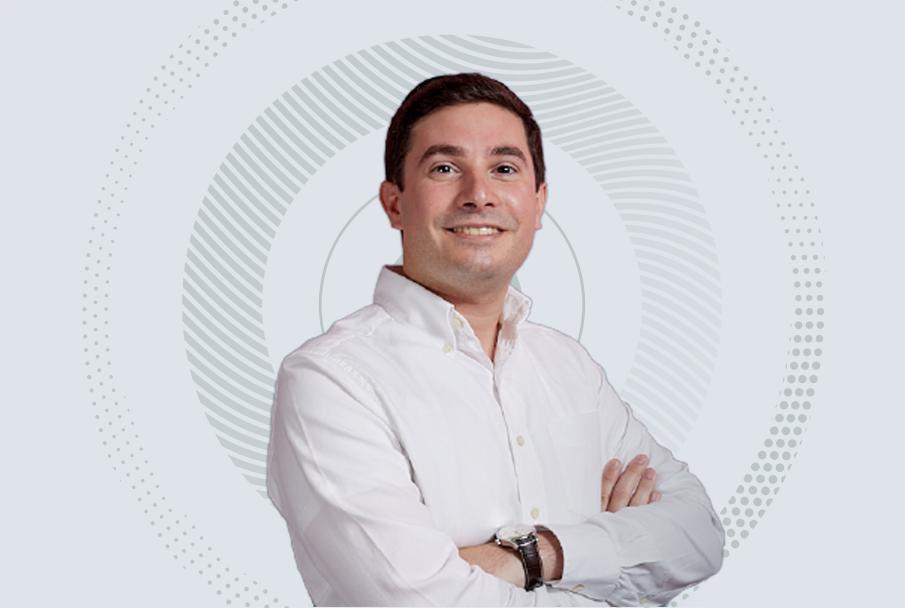
This is the fourth scholarship that Dr. Ashkenazy, who specializes in quantum optics, has won in the past few months. He conducted his PhD under Prof. Eli Cohen and Prof. Dror Fixler, and will soon be leaving for his postdoctoral studies in California
Dr. Ariel Ashkenazy, a Faculty of Engineering alumnus, has won the PBC Scholarship for postdoctoral students in the field of quantum science and technology. This is the fourth postdoctoral scholarship he has won in the past few months. Before that, he won the prestigious Fulbright scholarship from the U.S. Department of State, the PBC Diversity Fellowship, and Bar-Ilan's Diversity Fellowship, granted by the Gender Equity Unit.
Ashkenazy, 36, married with three daughters, began his academic career at our very own Faculty of Engineering. He has a BSc in Physics and Electrical Engineering, and an MSc in Electrical Engineering with a specialty in electro-optics. His PhD, which focused on quantum optics, was co-supervised by Prof. Eli Cohen and Prof. Dror Fixler. His research explored methods for the generation and detection of broadband entangled photons, and how they can be used in advanced quantum applications such as imaging and communications. Throughout his doctoral studies, Ashkenazy taught several undergraduate and graduate courses and even won an award for excellence in teaching.
In a few months, Dr. Ashkenazy will be leaving the Faculty of Engineering in pursuit of a post-doctorate at California's Chapman University, in Prof. Ebrahim Karimi's research group at the Institute for Quantum Studies. He will be researching nonlinear interactions of quantum light and matter, focusing on super-oscillation and how it can be harnessed in favor of advanced quantum applications.
The institute at Chapman was not a random choice: Dr. Ashkenazy had visited there in the past, at Prof. John Howell's lab, where he conducted a ten-day research funded by the BSF. The joint research investigated the properties of super-oscillating signals and their link to spatial and temporal super-resolution. During that visit, he also taught a seminar on the feasibility of implementing a photon-number splitting attack on quantum key distribution (QKD) protocols, and a method for real-time super-resolution.
We wish him the best of luck!
Last Updated Date : 31/03/2026