

On the Path to a Photonic Quantum Computer
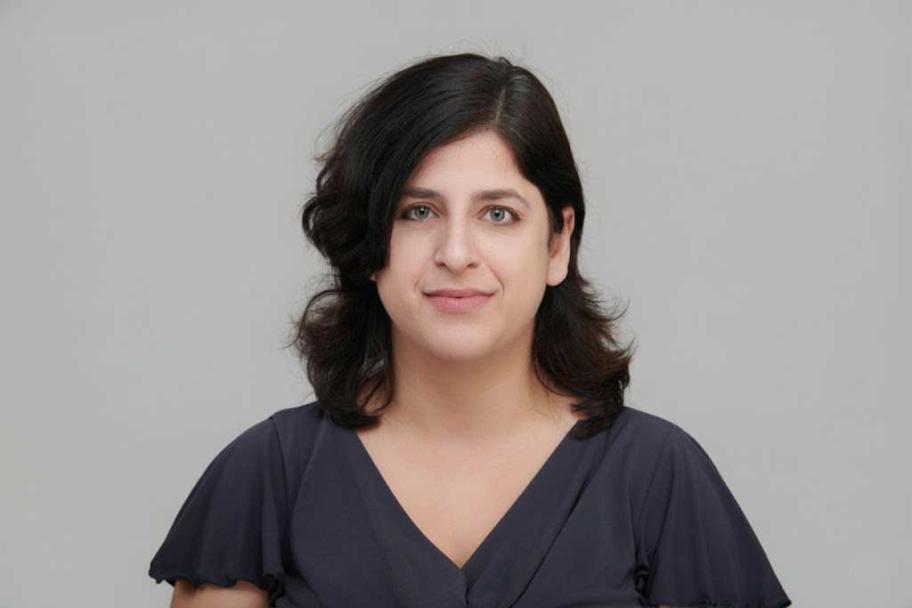
Dr. Miri Blau is establishing the Quantum Photonics Laboratory in the Faculty of Engineering. Using a first-of-its-kind system in Israel, she measures light at the single-photon level, and designs and fabricates components toward a light-based quantum computer
"There is only one person in this room who doesn't understand quantum mechanics right now; by the end of the lecture, I hope two hundred more will join them." Thus begins Dr. Miri Blau's quantum theory course. "It can be uncomfortable to tell students at an advanced stage of their degree: just trust me, this is how light behaves, even if it doesn't make sense. It goes against our intuitions and instincts as human beings, and even more so as physicists and engineers, people whose entire essence is to describe the world around us rationally," she says. "We want to explain things to ourselves in ways that make sense, and quantum mechanics is not intuitive. You can't see it, and it doesn't behave like anything else. It's very hard to communicate. We have to remember that many brilliant people, including Albert Einstein, believed, partly for this very reason, that the quantum mechanics theory was simply wrong."
At the Speed of Light
Dr. Blau found her calling in quantum physics at a relatively advanced stage of her academic journey, though her engagement with light, photonics, and optics was there from the very beginning. She completed her undergraduate degree at the Tal Institute, specializing in electro-optics. During her final project, carried out at the Soreq Nuclear Research Centre, she realized she wanted to continue and expand in the field. Her master's degree, which became a direct PhD, was completed at the Institute of Applied Physics at the Hebrew University, and focused on optical communications. "That was my opportunity to understand the enormous potential of every advance in optics: As the most efficient way to transmit information, our advanced infrastructure enables us to leverage every scientific development effectively.."
With the support of a Fulbright scholarship from the U.S. Department of State, she went on to pursue a postdoctoral fellowship at Columbia University. "It's not easy to relocate as a family with three children overseas, but it is a truly special experience. New York is an extraordinary place to spend such a formative period, and being in the United States gives you access to the most significant conferences in every field."
At Columbia, she joined Prof. Alex Gaeta's distinguished laboratory. This was the turning point at which she decided to focus on quantum phenomena of light, better known as quantum photonics. "When we want to say something is understood, we say it is 'clear' or 'enlightening'. But when you look at the most fundamental components of light, you encounter phenomena that are hard to grasp. The entire quantum world unfolds through the relationships between individual elementary particles. In the case of light, we are talking about photons. The unique behaviors described by quantum theory make it possible to perform computations that are impossible by any other means, or to achieve encryption that cannot be broken. Different laboratories around the world are attempting to create the conditions for these behaviors using different particles. In this context, photons have several notable advantages: they travel easily, their losses are low, they exist at room temperature, and, perhaps most significantly, we already have an infrastructure suited for them. Every breakthrough in quantum photonics has the potential to bring about a genuine revolution."
The Nano Center
In 2025, Dr. Blau returned to Israel and started the academic year by joining the electro-optics track in Bar-Ilan's Faculty of Engineering. She is currently establishing the Quantum Photonics Laboratory. "I want to combine my practical knowledge and the infrastructure here at the university to design and fabricate unique optical components for the development of quantum capabilities in computing and communications," she states.
"Quantum research in my field typically involves three stages: designing, fabricating, and characterizing a photonic component; conducting the experiment itself, which usually involves passing photons through the component; and measuring the photons after they pass through. Each stage demands careful attention, precision, and a great deal of specialized equipment."
Dr. Blau has also joined BINA, Bar-Ilan's Institute of Nanotechnology and Advanced Materials. The institute's instrumentation is precisely what is needed to fabricate the type of photonic components she studies. "Photonic components are miniature structures that guide light in a way that produces a quantum state change. For instance, computing the permanent of a matrix is something we know how to achieve through such means. One of the most innovative instruments at the Nano Institute is the nanoscribe, which is essentially a 3D printer with a resolution of just dozens of nanometres. Each print is an experiment in its own right due to the dimensions and specific design. After printing, we use an electron microscope to image the component and verify whether we have achieved the desired result. The nanoscribe at Bar-Ilan is the most innovative of its kind in Israel. In that regard, there's no better place to print such components than at our university."
Experiment and Measurement
But the challenge does not end there. "It is not enough to fabricate a component that is supposed to perform a computation; we want to see that the computation is actually carried out," she explains. To do this, light must be guided through the component. But as you might expect, this is no ordinary torch we are using. "Since we need single photons, we first have to create them. We use optical chips with cavities. Passing weak light through this cavity triggers nonlinear processes that emit individual photons. These are the photons we need to direct into our printed components in order to observe the quantum computation."
And finally, we reach the part that Dr. Blau considers the greatest challenge: measurement. In this area, her laboratory is set to be one of its kind in Israel. "Even the most sensitive detectors are not sensitive enough to capture a single photon. Yet that is precisely the sensitivity required to identify a successful experiment."
The instruments she needs are being custom-built by a Swiss institute specializing in this field, and they are expected to arrive at the university in the coming months. With these in hand, Dr. Blau's laboratory will join a very small number of labs worldwide capable of measuring such phenomena. She explains why this is such a significant challenge: "The detector that enables single-photon detection consists of a silicon wire that, at very low temperatures, becomes a superconductor. This superconductivity is sensitive to the impact of a single photon, and we are able to measure the resulting change in conductivity." This is not your standard home freezer – "the desired temperature is less than one degree above absolute zero."
Looking Ahead
With the system on its way, Dr. Blau believes she will be able to harness the achievements made to date in quantum photonics and take them to the next level: more photons, greater complexity, and scalable systems that can be expanded to a size with real-world applications. "With this system, it will be possible to measure up to 40 photons simultaneously," she says.
She is looking for master's and doctoral students, as well as advanced undergraduates, to join her new laboratory. "Every stage in the process I described requires expertise and a great deal of trial and error. One of the things that drew me to this field is my curiosity and enjoyment of discovering new things. But no less important is the ability to handle frustration and not give up. Research is frustrating. Sometimes you work for years without knowing what the outcome will be, or even what tomorrow morning will bring. But when you succeed, the satisfaction is truly unparalleled.," she shares. "I am therefore looking for curious, talented men and women who find quantum photonics genuinely interesting, and who are prepared to meet these challenges in order to discover something new."
Coming Soon: A Student Club for Women in the Faculty
Alongside her research, Dr. Blau will begin teaching a course on advanced topics in optical communications, aimed at third- and fourth-year students in the electro-optics track and graduate students in electrical engineering.
She is also establishing a women's student club within the Faculty of Engineering. "Throughout my academic career, I have almost always been the only woman in the room, and that was a challenge and a source of frustration. I raised the issue with Prof. Orit Shefi, Dean of the Faculty, and we both feel we can promote and encourage women in the field and to aspire to reach a point where 50% of students in the Faculty are women, and where engineering is no longer a male-dominated profession. My dream is to walk into a classroom and not personally know every single female student by name.
To the lab website
Last Updated Date : 24/03/2026