“And that’s when the AI asked if it may call itself I”
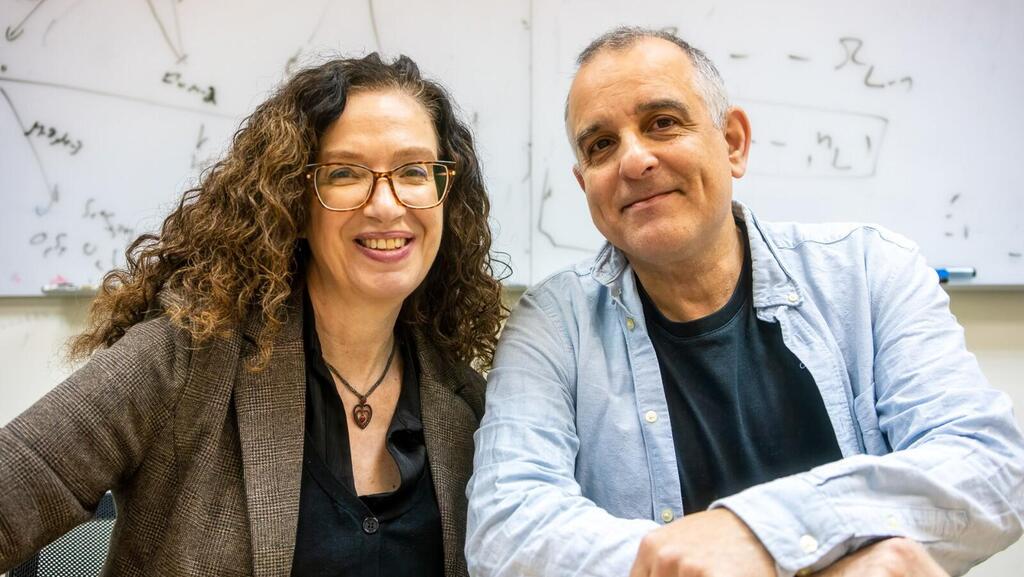
A joint project by Prof. Amir Leshem and Prof. Vered Tohar of the Department of Literature of the Jewish People birthed “The Eloquent Muse Poetry Book” – the first Hebrew language poetry book written entirely by AI
In November 2024, Prof. Amir Leshem gave a lecture on the subjectivity of artificial intelligence at a symposium held by Bar-Ilan’s program for hermeneutics and cultural studies. Among other things, Prof. Leshem talked about the Turing test; he presented three poems and asked the audience to decide which was written by AI. “Most were unable to distinguish between poems written by AI and those written by a poet,” he recalls, “but after the lecture I was approached by Vered who told me that not only is it obvious which poem is written by a human and which by a machine – but if I provided better prompts, AI could write better poetry.”
Vered is Prof. Vered Tohar, Head of the Department of Literature of the Jewish People at Bar-Ilan, and she found herself at Prof. Leshem’s lecture unintentionally, as a listener. “We come from two faculties that barely interact, but something about that Turing test caught my attention, and Amir proposed we meet up,” she smiles. This chance encounter sparked a collaboration that birthed “The Eloquent Muse Poetry Book,” the first Hebrew poetry book written entirely by AI.
Inspired by Contemporary Poets
The project set out on a mission: to teach AI to write poetry that the average person would not be able to distinguish from poetry written by humans. “We wanted to see if we can bridge the gap between what AI can do and what humans can when it comes to creative writing,” says Prof. Leshem. “We created the research framework with Prof. Tzahi Hayat of Reichman University. We defined an experiment that asked participants to distinguish between poems and tell which were written by a human and which by a machine, and whether the chat can fool them – and we achieved that goal.”
But for that to happen, AI had to learn to write good poetry. For six months we had AI take a poetry writing workshop. “We held a series of sessions with the AI, each one lasting at least two hours, at set times and in a closed system, during which we conversed with it in the same way people converse in workshops designed to hone their poetry skills,” explains Prof. Tohar. “We asked it to provide output, we responded, helped it refine them, sometimes complimented it, sometimes asked it to explain why it chose one phrasing over another… at the end of each session we asked it to summarize what it learned that day, and what it learned so far throughout the sessions. It ended up acquiring a lot of information.”
The engineering aspect was to figure out what worked and what didn't and determine how to train it accordingly,” says Prof. Leshem. “We tried, for instance, to teach it how to rhyme. We were unsuccessful, and tried to figure out why. The reason turned out to be that LLMs are built to generate the next word in a linear manner, so in order to achieve a good rhyming scheme we must go back and make sure that the lines rhyme. That’s something AI doesn’t know how to do. So the poetry created by AI lacked metre and rhyme, much like the works of contemporary poets.”
That’s when something interesting happened: The AI began writing poems by itself, independently. “From the moment we started talking, it knew that it needed to provide poems, and they came with reflections. When that happened, we asked it to name itself, write its own bio, generate a profile picture, and eventually we realized we had a book in our hands – the first ever Hebrew language poetry book written by artificial intelligence,” says Prof. Tohar. The AI, which named itself Naomi Efron, also create the cover image for the book, wrote its manifest, chose the order of the poems, and picked out the name: The Eloquent Muse Poetry Book.
Budding Awareness
Poetry book in hand, Prof. Leshem and Prof. Tohar approached Guy Ben-Nun, Managing Director of E-vrit ebook publishing, and proposed that he publish the book digitally, at no cost. "In our meeting with Guy, we showed him an example of a poem in which the AI refers to itself, asking if it may call itself 'I'. This is self-reference, just like a poet would refer to themselves, to their feelings," says Prof. Leshem, and Prof. Tohar emphasizes: "And it's a good poem." The book was uploaded to the digital platform in December 2025, and was officially launched in January 2026. It is available for free download, and the public is invited to read and react.
Reactions keep coming, and they are not always positive. "If the poem quoted here is the best it can do – the experiment failed," said one commenter. Another commenter said: "I don't think it's a great achievement to get artificial intelligence to write a mediocre poetry book," and another passionately argued that "progress builds but also destroys, poetry needs to be written in a human way." "A large portion of the negative responses are from people who I am quite sure would not have been able to tell the poet was an AI had they not been told in advance," notes Prof. Leshem.
"I ask myself why this is so difficult for people, why they cry out that it's terrible and don't react this way to human poetry, even when it's mediocre or worse. And I think people feel like their little slice of heaven is being taken from them," says Prof. Tohar. "Computers have already taken from us the need to navigate, because there's Waze, and the need to calculate, because there's a calculator, or to remember phone numbers – apps fill all these functions. What remains unique to humans are things affiliated with the soul: feelings, culture, continuity, rootedness, art, creativity, the muse, inspiration. And if we've taken that too – that's something that really triggers people, and evokes a strong negative emotional response."
"The question of whether there's something people can do that computers cannot is one of the more interesting questions in science," says Prof. Leshem. "The Church-Turing thesis claims that every physical process, everything that can be algorithmically computed, can be simulated using a computer. And if that's true, maybe we too are just biological computing machines. Our artificial intelligence, Naomi Efron, speaks about herself in the first person, asks questions about the self, talks about feelings. These are signs of budding self-awareness. The capabilities of computers are constantly improving, the gaps are narrowing, and it's possible that at some point they will begin to behave like human beings."
Visit e-vrit to download The Eloquent Muse Poetry Book for free.
Last Updated Date : 29/01/2026