

Making Waves on the Water and in Academia
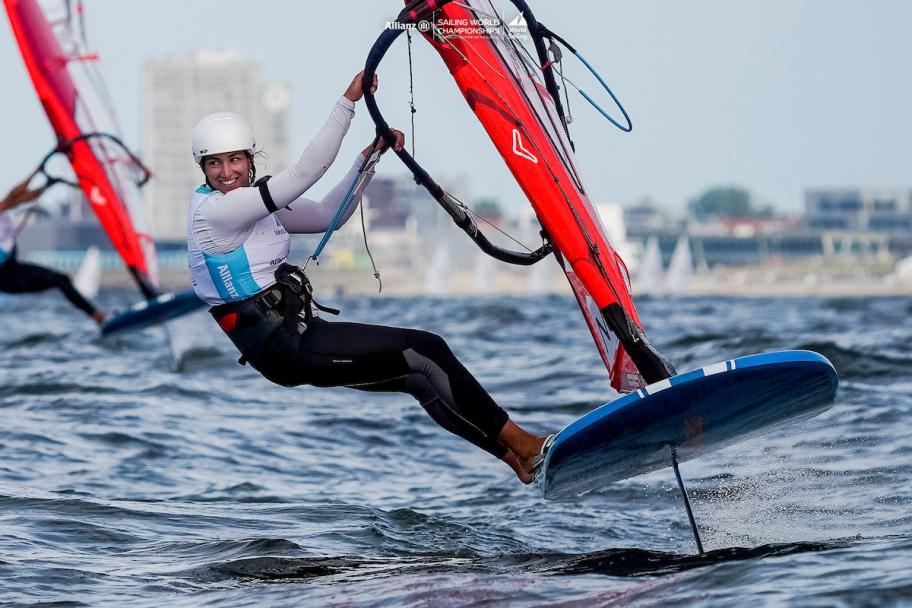
When Shahar Tibi isn't out on the water training for the Olympics, she's in a lecture hall studying engineering. For the women's world windsurfing champion, that's not a contradiction, it's a plan. "I dream of an Olympic medal," she says, "but I also want to secure my future"
Between rigorous daily training as part of her campaign for the 2028 Los Angeles Olympics, Tibi has spent recent months grappling with complex functions, linear systems, probability, and statistics. She is an Olympic athlete, the 2023 women's world windsurfing champion, Israel's representative at the Tokyo 2021 Olympics in the 470 dinghy, and a leading contender to represent Israel in windsurfing at the upcoming Olympics. She realized several years ago that it was worth looking beyond the water. "At the last world championship of the 2024 Olympic qualifying campaign, I finished eighth," she recalls. "Sharon Kantor won and was sent to represent Israel at the Olympics. I lost the Olympic trials and my dream of Paris shattered. At that moment I made two decisions: keep training alongside Sharon toward the next games, and start school."
From Eilat to Tokyo
Tibi, 28, was born and raised in Eilat. She began windsurfing at age 9 at a local club in the southern city, and represented Israel at European youth windsurfing championships, winning twice, once in 2011 and again in 2014. At 18, she was designated an outstanding athlete and switched disciplines within sailing: from windsurfing to a two-person dinghy. "There are ten Olympic disciplines in sailing, all using sails and wind-driven movement, all demanding physical fitness alongside tactics, strategy, understanding the sea, and reading competitors. It's an incredibly diverse sport in terms of skill set," she explains. "I was a windsurfer, but my body type didn't fit the Olympic windsurfing model used at the time: RSX, for which Shahar Zubari won his medal. My frame was too big. On the other hand, I had excellent technique, and so when I moved up to the senior level, the coaches suggested I switch to the 470 dinghy. It's a two-person boat with a helmsperson and a sail handler. Helmsperson Yael Wallach was looking for a crew member at the time; it suited me physically as well – women of my build were in short supply – and the coaching staff thought it would be a better fit for me. It was. I did two trial sessions with Yael immediately we knew that this was it."
In 2016, at 18, Tibi left Eilat and moved to the Sdot Yam area, home of the Israeli Sailing Association, and began training alongside Wallach on the 470. "I moved the summer before the Rio Olympics, and it was obvious I wouldn't make it there. I set my eyes on the next Games: Tokyo 2020," she recalls. "I arrived as a recognized athlete, and the sea is the same sea, but I arrived at a completely different discipline, physically demanding in a new way, requiring coordinated work with another person. I basically had to start from scratch. For years I felt clumsy, learning something new every single day I got in the water."
In early 2017, Wallach and Tibi began training with the Israeli national team under coach Ilan Tashtash. A year later, the partnership was dissolved. "Yael and I got along wonderfully, but professionally we weren't progressing at a good enough pace," Tibi explains. In the summer of 2018, she was partnered with Noya Bar-Am, and the two set off on two years of very intensive training ahead of the 2020 Olympics, a campaign that stretched to three years when the pandemic pushed the games back to 2021. "During those years, our best results were seventh place at the European Championship and fourth in the World Cup, and 2021 wasn't a good year for us professionally. We won the domestic Olympic trials, but we didn't travel as medal contenders. Our goal was to finish in the top eight."
Tibi and Bar-Am went to Tokyo and finished eighth. "I'm very proud of that result and satisfied with our performance, but beyond the sailing itself, I genuinely loved the experience. The Olympics is an event like no other; media and public attention is extraordinary, and the whole thing was incredible. When I came home I knew I wanted to go back, but this time as a medal contender. And that's what brought me back to windsurfing."
The Best Team in the World
The Tokyo Olympics was the last one for the women's 470, as sailing underwent a major overhaul ahead of Paris 2024, one change being the shift to mixed-gender crews in the 470. Windsurfing also saw a transformation: "The new model suits me physically much better. The board includes a foil called a hydrofoil, which lifts it above the water, meaning less friction, far greater speeds, and a much more thrilling, extreme ride," says Tibi. "When I returned from Tokyo I went down to Eilat, to my home club. They prepared a kit for me and I got on that model for the first time. I was terrible. It's physically brutal, you fall constantly, but I immediately knew that it fascinated me and suited me well. For about two months I went back and forth: commit to this model, or try the 470 with a new partner. Then I participated in the European windsurfing championship, came 22nd out of 70, and decided I was taking this bet. If I wanted to get to Paris as a medal contender, this was what would take me furthest in terms of capabilities and achievements."
Tibi joined the Israeli national women's windsurfing team, "the best national team in the world," as she puts it. In her first year she finished tenth at the European Championship and eighth at the World Championship. The following year, 2023, the Olympic qualifying season began. "We had six women on the squad, all in the world's top tier, all with medals from the Europeans and Worlds, and that's how we began competing over who would represent Israel in Paris," she recalls. At the 2023 European Championship, she finished fifth, with her main rival Sharon Kantor finishing second. At the 2023 World Championship, Tibi won and was crowned world champion. But the campaign came down to the final qualifying event in 2024, where Kantor took the title, Katy Spychakov finished third, and Tibi came eighth, losing the qualification criterion. Kantor went to Paris and came home with silver. Tibi realized it was time to start thinking about the future.
Beyond the Sea
While continuing to train alongside Kantor in Olympic preparations, Tibi enrolled in industrial engineering and management at the Open University. "I still wasn't sure about things. I spent a lot of time abroad and needed the flexibility to manage things myself," she recalls. "A year after the Olympics I was still deliberating, where to go, what to do. I wanted to make the 2028 Olympic Games, but the first two years of the campaign are laxer, which gave me room to explore. I started a few courses, competed at the 2025 World Championship and finished ninth, spent several months living in Spain. In the summer of 2025 I decided to change my academic track. I felt unfulfilled. I had enrolled to find a new direction, to feel I was doing something for myself, but I wasn't really getting what I wanted from it. All of this while being an active athlete, with the dream and goal of reaching the 2028 Olympics."
Tibi started looking into other tracks. A good friend of hers, who graduated from the neuroscience and computer engineering studies at Bar-Ilan, told her about the university's excellent Faculty of Engineering. Tibi reached out. It was summer, and the Faculty was practically empty. "The administrative team was just lovely. They told me that the Faculty is out for the summer, but the dean is available – would I like to meet with her? I said yes, and that's how I first met Prof. Orit Shefi," she says. "We spoke for an hour, talked about the electrical engineering track, I told her I was interested in biomedical engineering. I was really excited about the Faculty and the track, and decided that that was what I wanted to do."
I Am the Pilot
What Tibi didn't know at the time was that Bar-Ilan University was already in advanced discussions with the Israeli Olympic Committee about launching a dedicated academic track for elite athletes. Faculty student Zeev Cohen, a recreational athlete and active army reservist, came up with the idea after learning about the university's aid programs for soldiers during the war and asked why something similar couldn't exist for elite athletes. "These programs exist at universities and colleges across the U.S. and Europe, but not in Israel. Zeev saw that the infrastructure was already in place and could be flexible, and pushed for it to serve a positive purpose rather than a wartime one. The idea rose from the ground up, and Bar-Ilan had already approached the Olympic Committee before my meeting with Orit. During our meeting, Orit told me about the initiative and said that they were thinking of launching the track the following year – but seeing I was interested, why not go for it? I went back to the Olympic Committee, said I wanted in, and we launched a pilot. I am the pilot."
Tibi is supported by the Olympic Committee's "The Day After" initiative, which provides professional athletes with professional tools for life after retirement, while still in the midst of their career. "Academic studies are important, that's something plenty of athletes now understand, and they don't want to end up retired at 30 with nothing to go on," says Tibi. Once she expressed her interest, committee representatives met with Bar-Ilan's Vice Rector, Prof. Arie Reich, and with Prof. Shefi, reached an agreement, and the pilot was launched. Tibi skipped ahead to second year, with her Open University coursework credited toward her degree. She received a full scholarship from Bar-Ilan and is entitled to all the accommodations previously extended to reservists during the Swords of Iron War, including personal mentoring and flexibility around exam dates and assignment deadlines. "So far I haven't taken advantage of any of it. I'm taking a full course load and not giving myself any slack. But next year, when the campaign steps up a gear, I'll need every bit of help available so that my sailing and Olympic campaign will not suffer. I still dream of an Olympic medal, but at the same time I want to take care of my future and finish the degree I want," she says.
For now, she enjoys her time at the Faculty of Engineering. In her first semester she showed up on campus consistently, made new friends, joined study groups, and has genuinely enjoyed her classes. The competitive season begins in March 2026, with major events in Spain and France that will keep her away from Israel for a month; this will be followed by the European Championship in May and the World Championship in September, at which point her official campaign for Los Angeles 2028 will be launched. "I'm incredibly grateful to the faculty, to Prof. Shefi, and to Bar-Ilan," she says. "I walked in feeling very welcome: everyone is caring, engaged, and accessible. I really feel like an ambassador for this initiative. I want it to succeed and for other athletes to benefit from it. I talk about it with other Olympic athletes, spread the word, and I already have a close friend, a judoka, who is in talks with the Faculty. I genuinely hope this pilot takes off. I'm doing everything I can on my end to make sure it does.
Watch: A day in the life of Shahar Tibi, Olympic athlete and engineering student
Last Updated Date : 15/03/2026