

Researchers at the Forefront: Special Sessions in Honor of Women's Day
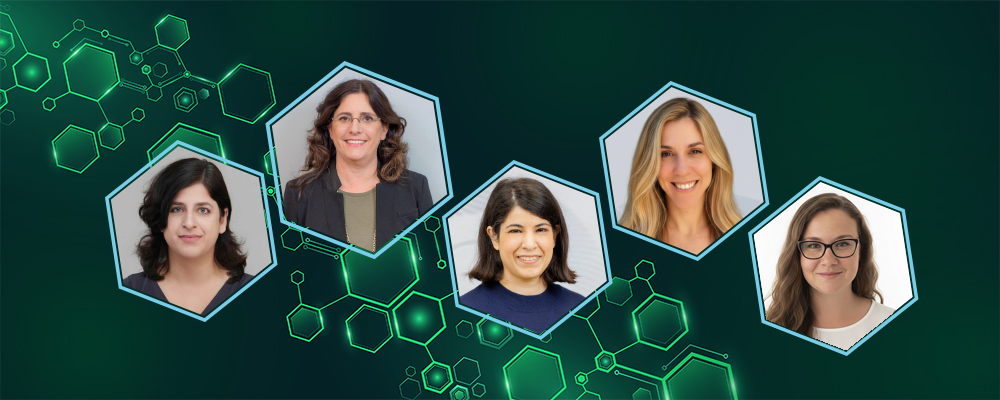
Due to the war, the Faculty of Engineering's 2026 Women's Day events were held online as a series of Zoom sessions featuring Faculty researchers. Participants spoke about their journeys, their research, and balancing career and family, sharing insights from their academic and professional experiences
The Faculty of Engineering marked Women's Day 2026 during the second week of March with a series of inspiring Zoom sessions featuring Faculty researchers. "The goal was to host a different researcher from the Faculty in each session for a short, open, and honest conversation about her research and professional path," explains Prof. Orit Shefi, Dean of the Faculty and initiator of the idea. "The talks offered a glimpse behind the scenes of the featured researchers' careers and included topics such as managing a career and family life, and various strategies for maintaining a successful balance. These were fascinating conversations, and the audience, of course, was given the opportunity to ask questions."
Do Not Fear Failure
The sessions were all held during the second week of March. In the first session, Dr. Michal Yemini interviewed Dr. Miri Blau, who recently joined the Faculty of Engineering after completing her post doctoral studies at Columbia University. Dr. Blau spoke about her academic path and shared advice on managing an academic career. "I emphasized how important I believe persistence is," says Dr. Blau. "For example, regarding scholarship applications: I apply constantly, even if I know the chances of winning are low, because one of the most important things in a research career, and life in general, is to not fear failure. This results in two things: first, learning to get up after a failure and try again. The second, and opposite, is adopting the ability to dwell on successes. This is the ability that strengthens and illuminates the path forward."
Aim High
In another session, Dr. Alexandra Simanovsky from the Data Engineering program interviewed Dr. Yoli Shavit, a researcher at the Faculty and AI research lead at NVIDIA. "I started in medical studies, but one exercise in computer science was enough to change my course," recalls Dr. Shavit, who completed her PhD in computer science at the University of Cambridge and gained extensive research experience at leading startups and corporations such as Amazon and NVIDIA. Her advice combines curiosity with a drive for excellence: "If you don't know exactly what you want, follow your interest and aim as high as possible. This combination paved the way for me from academia abroad, through leading technology companies, to establishing my own lab."
According to Dr. Shavit, the key is trying to answer the question: What do I want to do in five years? She clarifies that this is not about rigid planning, but about refining one's sense of direction: "Once I defined the goal for myself, achieving it became much easier." Even in the AI era, she sees it as a tool for fulfillment: "Artificial intelligence opens up tremendous possibilities, but it does not replace personal navigation. Do not be afraid to define a goal even under conditions of uncertainty. This precision is what allows you to harness technology to solve the challenges that truly interest you and to open new doors."
Find the Heart
Prof. Shefi not only initiated and organized the series but also participated in one session with Dr. Michal Yemini. "I talked about my path, from my beginnings as an academic reserve student to my service in the Intelligence Corps, and on to my master's and doctoral degrees, when I began to take an interest in the organization of the brain, my current specialization," says Prof. Shefi. "I shared that during my bachelor's degree, I didn't think about the master's, and during the master's, I didn't think about the PhD – but when I left for my post-doc at UCSD, I already figured out it was time to muster the courage to say: I want this. Throughout the journey, I never stopped asking myself what I actually wanted to do when I grew up, until I started my lab. That's when I felt I had found the answer, and I haven't regretted it for a single day since."
Prof. Shefi noted during the session that she loves the field of engineering because it is very broad, with many possible avenues. "In my lab, we try to decipher how our neural network – 88 billion electrically active cells – organizes into networks that transmit information, and to utilize these mechanisms to direct the growth of cells that have undergone trauma into a specific structure that will assist in neural rehabilitation. Work in our lab is very versatile, ranging from purely elementary research to the development of applied platforms and tools for rehabilitation," she explains. "My father always said it is worthwhile to study and engage in the core of the matter, the heart. I've always been drawn to STEM, so I chose physics and engineering. For me, that is the heart."
No Holding Back
During the sessions, the researchers offered advice and tips. "I, for example, never felt discriminated against for being a woman, but I did notice that women tend to hold back for various educational, social, or environmental constraints. The secret is to learn to eliminate these inhibitors and go after what we love and want with confidence," says Prof. Shefi. "Another excellent piece of advice was to find a peer group you can consult with, and I personally want to add: part of the fun in research is that we have the freedom to choose whom we work with."
"Another tip, which I also find very important, was that we don't always have to be the most outstanding person in the room," continues Prof. Shefi. "In this context, I relate to what Dr. Miri Blau said about the need not to fear failure. Women often feel the need to prove themselves, show they are better, smarter, faultless, and more deserving of the position they hold. It is important for me to say that sometimes, it’s okay to be like everyone else. Be exactly as you are – excellent."
We thank the faculty members for sharing their time and knowledge, and Dr. Pazit Polak for producing the event.
Last Updated Date : 31/03/2026