


I'm Here for the Eureka Moment!
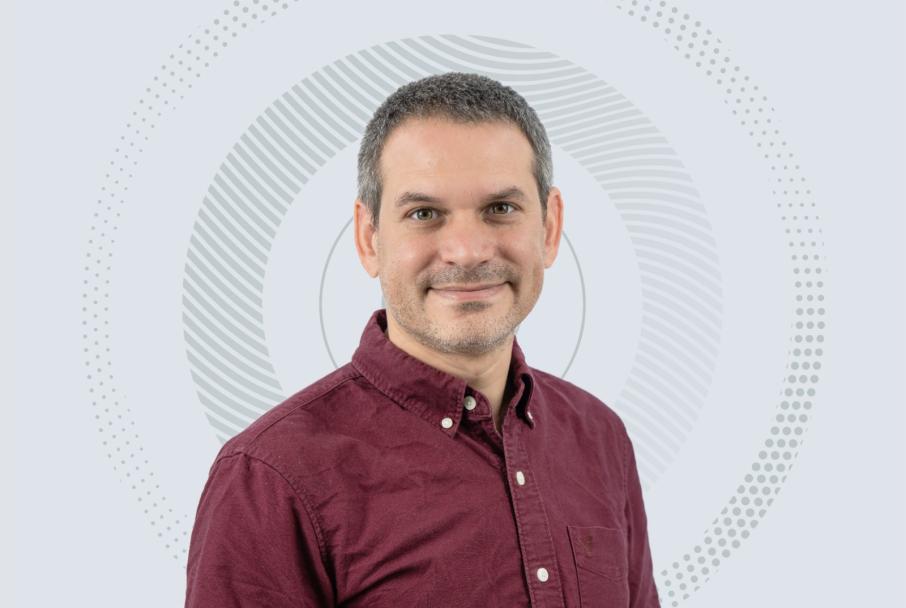
Dr. Yatir Sadia is establishing the Laboratory for Heteroanionic Materials – relatively rare materials with enormous potential for the energy market. "There is something very enticing about synthesizing a new material that doesn't behave the way you expected it to – and then you test it, and suddenly understand why"
When Dr. Yatir Sadia was deliberating what to study, he consulted his high school teacher. "I went to high school in the U.S., because we were there for relocation. We moved when I was 13 and I came back to Israel at 18, because I was homesick and wanted to return. But before that, I had the chance to consult with my chemistry teacher, and he recommended that I go study materials engineering," he recalls. "According to him, chemistry was less suitable for me, because the aspects I liked most in the field – the thermodynamics of materials, inorganic materials and how they function – are better suited to materials engineering. I also really liked physics, and the combination of chemistry and physics is stronger in materials engineering, and I wanted to do something that would also be interesting and practical. So I went with materials engineering, and I'm very glad he recommended it to me."
Dr. Sadia, 41, father of two sons, lives in Kibbutz Dvir in the northern Negev. He did his bachelor's degree as an academic reserve at Ben-Gurion University. After completing his military service, he went on to pursue a master's and doctoral degree in the Department of Materials Engineering, focusing on thermoelectric materials. "During my bachelor's degree I met Prof. Yaniv Gelbstein, a leader in this field at Ben-Gurion. I started my master's with him, fell in love with the field, and continued this partnership throughout my doctoral studies as well," he says. He did his postdoctoral fellowship at Imperial College London with Prof. Stephen Skinner, a world expert in solid fuel cells, where he focused on SOFC-type fuel cells. "These are fuel cells that operate at high temperature with high efficiency, around 600–800 degrees, and you can feed them hydrogen, ammonia, or hydrocarbon fuels, and get up to 60% efficiency from them, meaning they are more efficient than a power station." In between, he also worked in the industry.
After completing his postdoctoral fellowship, he returned to Israel and joined the Faculty of Engineering at Bar-Ilan, in the Materials Engineering program. He continues to focus on thermoelectric materials and ionic conducting materials. "Thermoelectric materials are materials that take a temperature difference and generate electricity from it, or are able to transfer heat from one place to another when an electrical current is applied to them, so they can be used to convert electricity to heat or cold, and vice versa. Ionic conducting materials are materials that have a range of properties and uses for various applications, mainly in the energy field," he explains.
New Materials for Maximum Energy Utilization
Today, his main focus is on a relatively unexplored group of materials called heteroanionics, which are materials that have more than one type of anion within the same structure. "An anion is the negative element in a compound. If we take oxygen, for example, heteroanionic materials containing oxygen and something else can be, for instance, oxyfluorides, which is oxygen and fluorine, or oxychalcogenides, that is, oxygen and sulfur, selenium or tellurium" he explains. "These are materials that are very difficult to synthesize because of the conditions required, and this is why they have been scarcely studied. But their potential is very great, because they have properties suited to a wide range of applications, and they can serve, for example, as superconductors, materials for batteries, fuel cells, magnetic materials, and more."
These days, Dr. Sadia is establishing the Laboratory for Heteroanionic Materials, in which he focuses on researching electrical and ionic conductivity properties, primarily in new materials that have not been studied before, for applications such as thermoelectrics. "In my lab, we create new materials and study their properties, putting emphasis on energy applications. In the future, materials of this type could, for example, convert the heat that accumulates from microchips into electricity, or alternatively cool them, something that is highly relevant in the AI era. There is a very, very large amount of heat produced by server farms today, and these materials can help cool server farms and provide better energy utilization," he says. He is looking for research partners, graduate students, preferably with a background in materials engineering.
Alongside his research, he teaches the courses "Materials Science 2" and "Materials Laboratories 1: Mechanical Properties." He loves the academic world. "In the world of research there is that moment when there are results you don't know how to explain, and nothing adds up, and then you look under the microscope, and suddenly you shout Eureka! like Archimedes in the bathtub," he smiles. "There is something very enticing and very attractive about creating a new material, testing its behavior, seeing that it doesn't match how you expected it to behave – and then you examine it properly, and suddenly understand why. That moment of understanding, that's what I'm here for."
Last Updated Date : 26/04/2026