

Dr. Yossef Panfil Grows "Defects" That Will Form the Basis for Quantum Technology
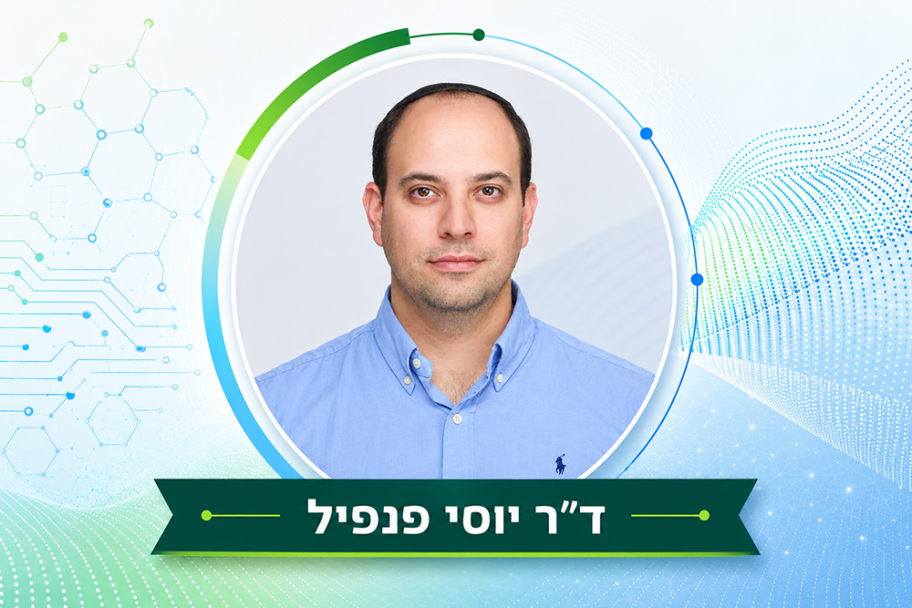
Dr. Panfil's research, which won him the Bereshit grant from the Israel Science Foundation, creates controlled defects in colloidal nanocrystals. The defects give them quantum properties, turning them into building blocks for quantum computing, encryption, and sensing
Colloidal nanocrystals – tiny semiconductor particles synthesized in solution – are usually prized precisely for their perfection. For decades, chemists have been refining their synthesis methods to obtain flawless nanocrystals of maximum efficiency, whose size alone determines the color of the light they emit and whose shape determines optical properties such as polarization.
Dr. Yossef Panfil, a new faculty member and winner of the Bereshit grant from the Israel Science Foundation, does exactly the opposite. Rather than striving for perfection, his lab deliberately replaces a single atom in the nanocrystal's lattice with a carefully selected impurity, creating a "color center" – a point defect that emits and absorbs light at specific wavelengths and gives the crystal quantum properties. "I want to produce properties that sound like science fiction, and the way to get there is through defects," explains Dr. Panfil.
A key aspect of the research is identifying the right combinations of defect and host material, so that the defect's spin preserves a state of quantum superposition (simultaneous existence in two states) for a long time, even at room temperature, without requiring the enormous cryogenic cooling systems currently used for quantum computers such as Google's. These same color centers also serve as single-photon sources for quantum encryption and as quantum sensors sensitive to magnetic fields at nanometric resolution, for use in GPS-free navigation and imaging beyond the capabilities of classical detectors, among other applications.
"The geopolitical implications of quantum computing may prove even more significant than the space race of the previous century. It's not just the ability to break encryption – it's the ability to solve problems we simply cannot solve today, from discovering new materials to finding new drugs to treat diseases," says Dr. Panfil. "Every computing revolution begins with a breakthrough in materials. Classical computing had silicon. We are still looking for its equivalent in quantum technology – and that is exactly what my lab is trying to find."
The prestigious Bereshit grant is a nationwide initiative to encourage outstanding young researchers to return to Israel and join the academic faculty at Israel’s universities after completing their postdoctoral fellowships abroad. The grant is awarded to about 15 researchers each year and guarantees a five-year funding package that includes generous research grants, budgets for laboratory setup and equipment, and a personal integration grant. Dr. Panfil is one of four Bar-Ilan University researchers who won this year's grant.
Last Updated Date : 31/08/2026