


Dr. Amir Weiss Presented Two Papers at ICASSP 2026
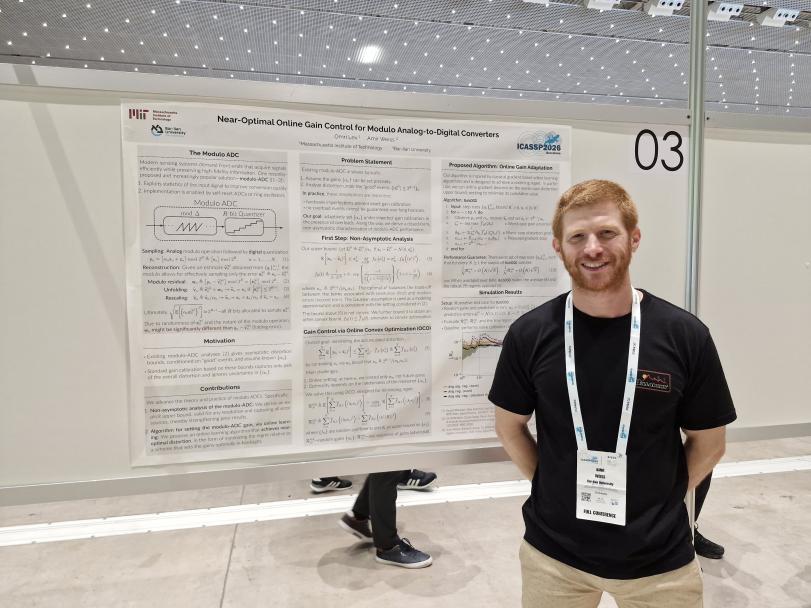
ICASSP is the leading international conference of the signal processing community. Dr. Weiss's papers addressed task-oriented compression that preserves information critical for direction-of-arrival estimation, and a novel algorithmic framework for an innovative digitization architecture for handling signals with a wide dynamic range
IEEE ICASSP 2026 is the international flagship conference of the signal processing community, held this year in Barcelona. Dr. Amir Weiss of the Faculty of Engineering presented two new papers in his line of research: signal processing techniques for applications involving distributed sensing from multiple sensors, task-oriented data compression, and the development of theorey and algorithmic methods for extracting accurate information from compressed measurements.
Task-oriented direction-of-arrival compression
The first paper, Joint Compression and Direction-of-Arrival Estimation in Distributed Sensor Networks, explores distributed sensing systems in which multiple sensors receive signals from a source located in an unknown direction, and due to communication constrains, they can only transmit a compressed version of the received signals to a processing center. The paper examines how to compress information so as to preserve primarily what is important for the task itself: accurate estimation of the signal's direction of arrival.
The key point is that in modern sensing systems, efficient compression is measured not only by signal reconstruction fidelity, but also by whether it preserves the information needed for decision-making or accurate estimation, and more broadly for specific statistical inference. The method presented in the paper exhibits superior performance compared with existing methods and approaches the performance attained by a theoretical benchmark.
Novel algorithms for a modulo-based sampling architecture
The second paper, Near-Optimal Online Gain Control for Modulo Analog-to-Digital Converters, co-authored with Omri Lev of MIT, deals with modulo analog-to-digital converters — an innovative sampling architecture that enables handling of signals with a wide dynamic range through controlled "folding" of the signal prior to sampling and digitization.
The paper proposes an online gain control method that enables the system to adapt in real time and improve reconstruction accuracy even in the presence of constraints and inaccuracies in the system's analog components. The paper links sampling theory, online learning, and adaptive digital filtering, and advances efficient sampling solutions for future systems with hardware limitations.
Sensing, digitization, and task-oriented compression: the next generation
Both papers present complementary aspects of the same research vision: in modern digital systems, where information is measured, sampled, and transmitted under various practical constraints, the challenge is not only to collect more data, but to design the measurement and processing pipeline in a way that perfectly preserves the information vital for the task. These papers demonstrate how the combination of mathematical theory, algorithms, and practical signal processing can lead to more efficient methods for next-generation sensing, sampling, and compression systems.
Last Updated Date : 28/06/2026