
A Faculty of Engineering Team Won First Place at the HackAgents BIU 2026 hackathon
The event was born of a special collaboration between the Faculty of Engineering and the Department of Computer Science and Artificial Intelligence, created with the goal of pushing boundaries and nurturing the next generation of intelligent agents. The initiative was led on behalf of the Faculty by Dr. Ofir Lindenbaum and Dr. Alexandra Simanovsky
A hackathon is not just any event – it is the place where ideas become working prototypes within 24 hours. A hackathon is an opportunity for students to gain hands-on experience with innovative technology, collaborate on real challenges, receive guidance from industry mentors, and above all, develop a project that can go into their portfolio and even serve as the basis for a future startup.
The HackAgents BIU 2026 hackathon is co-hosted by the Faculty of Engineering and the Department of Computer Science and Artificial Intelligence. This year, 37 teams, consisting of more than 100 undergraduate and graduate students, participated. On behalf of the Faculty of Engineering, the event was headed by Dr. Ofir Lindenbaum and Dr. Alexandra Simanovsky, with the encouragement and support of Dean Prof. Orit Shefi. The hackathon was held on Thursday and Friday in May 2026; over the course of 24 intensive hours, participants worked to develop solutions based on intelligent AI agents, driven by the understanding that the technological world is changing rapidly, and that AI-based agents are expected to play a central role in the years ahead.
Intensive work, close mentorship
Team representatives arrived on Thursday morning to attend a professional training session by Red Hat representatives on the technological tools, and to ensure the infrastructure was ready. At noon, the hackathon was officially launched at the central Meetup gathering, after which the teams moved on to intensive work developing their AI agents. The work continued into the night, during which participants focused on developing their prototypes and preparing for the judging stage.
Each team had mentors from the academic staff and from the event's supporting companies, chiefly Google and Cadence, the event's official sponsors. Additional mentors hailed from IBM, Red Hat, and Wix, to name a few. Members of the Faculty also contributed to the event's success, including Dr. Tom Tirer and Prof. Ran Gelles, who served as mentors and accompanied the teams throughout the development stages. Prof. Sharon Gannot served on the judging panel.
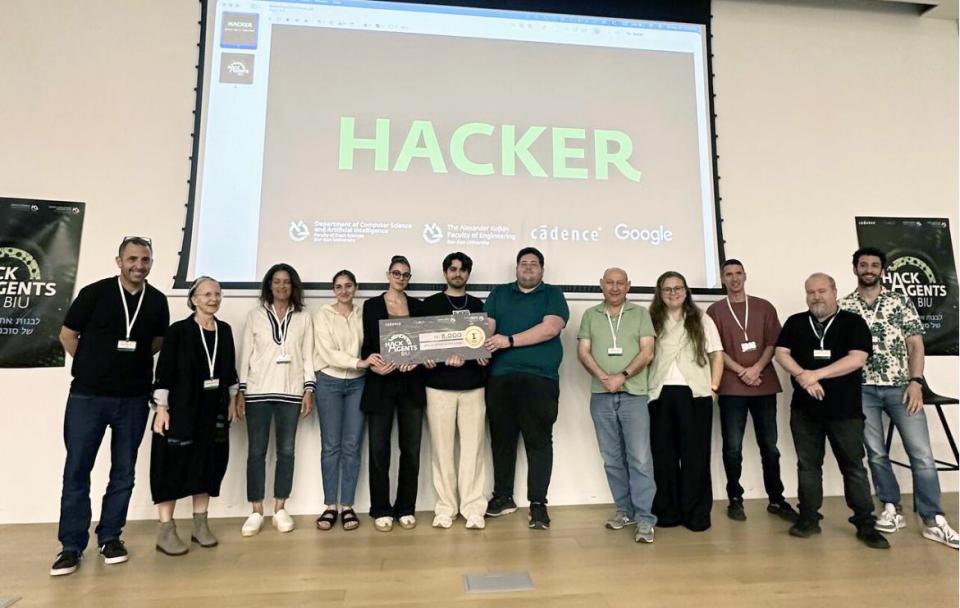
The winners were announced at noon on Friday, and the Faculty of Engineering brimmed with pride: First and third place went to groups from the Faculty of Engineering.
First place: Remote technical support technician
The top winning team consisted of second-year students: Yarden Karmi (Computer Engineering), Tal Segal (Electrical Engineering), Lee Sizniof (Computer Engineering), and Liav Samaya (Data Engineering). The hardware was contributed by Dr. Leonid Yavits.
The team's project is called VooDoo, an autonomous action agent that functions almost like a remote technical support technician: it can observe the user's screen, understand the technical problem at hand, and solve it autonomously by clicking and typing. Its advantage is that it operates continuously 24/7 and remembers every issue it has resolved in the past, in order to replicate its success.
Third place: An AI system for managing and understanding GitHub projects
Third place went to the team consisting of students Yaniv Ilan (first year, Master's degree in Mathematics with a Data Science track), Ofek Nasi (fourth year, Bachelor's degree in Computer Engineering and Mathematics), Nir Altahen, and Matan Lerner (fourth year, Bachelor's degree in Computer Engineering and Physics).
The project developed by the team is called Myna, an AI system for managing and understanding GitHub projects. The system tracks pull requests, commits, and code changes, and builds an ongoing "project memory" that summarizes what changed, who worked on what, which components were affected, and what it means for the team. What makes the system unique is that it not only reads the code files in the repository, but also learns who made the change and why. This allows it to rely first and foremost on accumulated memory, and perform additional in-depth checks only when necessary, thereby saving redundant scans, reducing hallucinations, and providing more accurate and reliable answers.
Last Updated Date : 03/06/2026