

Helping STEM Graduates Navigate Their Path to Industry
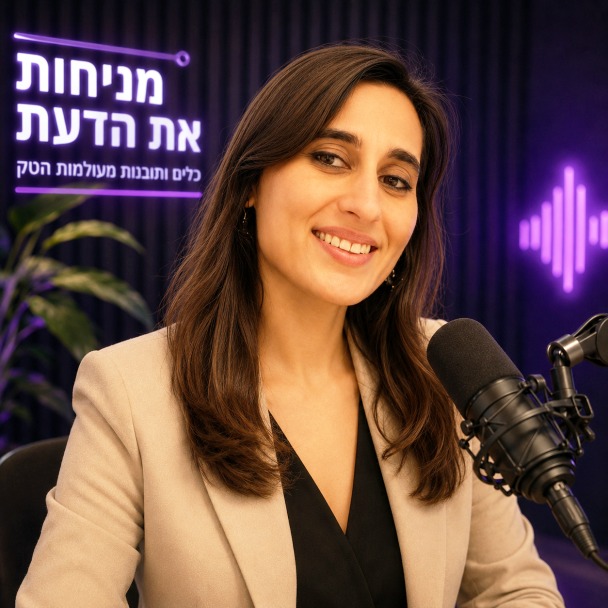
Throughout her career, Faculty of Engineering alumna Coral Cohen Zolkov has repeatedly encountered questions about breaking into industry and building a meaningful career. That is why she created a podcast that offers practical insights and experience from industry and entrepreneurship through conversations with accomplished women leaders.
How can you go from academia to a startup? How do you combine advanced studies with work? Does a PhD make candidates overqualified for industry positions? How should we prepare for job interviews and position ourselves professionally right from the first job? How do you build a meaningful career path in a rapidly changing world? And how can you benefit from the guidance of more experienced people along the way?
These are all questions that Coral Cohen Zolkov, a Faculty of Engineering alumna whose master's research was supervised by Prof. Ze'ev Zalevsky, encountered throughout her own journey. "As an undergraduate, I worked at a startup that grew out of academic research, and during my master's studies I collaborated closely with the semiconductor industry through my role in the field. Along the way, I repeatedly encountered questions from engineering and science students and recent graduates: How do you break into industry? How do you advance professionally? How do you combine research with a career? And what opportunities are available after completing advanced degrees?" she says. "These questions inspired me to launch Menihot Et Hada'at ("Ease Your Mind") – Tools and Insights from the Tech World. The podcast aims to provide students, graduates, and early-career STEM professionals with accessible tools, insights, and practical experience from industry and entrepreneurship."
The Importance of Academia–Industry Connections
Coral, 32, was born and raised in Sitria, near Rehovot. She began her scientific journey in high school at the Weizmann Institute of Science, where she participated in the Young Researchers Excellence Program and conducted research in physical chemistry of surfaces. She later earned a four-year bachelor's degree in Physics Education from the Technion, during which she participated in renewable energy research that eventually evolved into a startup. "That experience was my first realization of how powerful the connection between academia and industry can be," she recalls.
Toward the end of her undergraduate studies, she carried out two research projects, one in theoretical astrophysics and the other in physics education through student-led research. "Both topics fascinated me, but I felt the technological implementation was missing, so I pursued a master's degree in Electrical Engineering at Bar-Ilan University under the supervision of Prof. Ze'ev Zalevsky," she says. "After my first year, I began working full-time at Applied Materials. I worked on an advanced optical inspection system, laser-based microscope combined with sophisticated algorithms for detecting defects in semiconductor chips. I thought it would be a missed opportunity not to leverage this technology in my research. I proposed the idea to Prof. Zalevsky, and to my delight, he agreed."
Coral approached several senior physicists at Applied Materials to better understand the system's limitations and proposed developing solutions as part of her thesis. Two colleagues, Dr. Chaim Feldman and Mr. Benny Kirschner, embraced the idea. "The research focused on reconstructing the phase of the objective lens responsible for optical aberrations in the images produced by the system. We used images of structures on semiconductor wafers that we identified as suitable candidates for encoding the information required for phase reconstruction. Images were acquired at multiple focus distances to introduce phase diversity, and we used vectorial simulations incorporating scattering matrices to model optical distortions and different machine conditions that might be encountered at customer sites."
"I Realized There Was a Tremendous Need to Make This Information Accessible"
Coral spent three years at Applied Materials. In July 2025, she married Erez, whom she met during her studies at the Technion, and the couple later relocated to Los Angeles, where Erez pursued postdoctoral research in RF engineering at USC. After leaving her position, she continued receiving questions from recent graduates about careers in the semiconductor industry and how to break into the field. "I also saw friends and colleagues struggling with career transitions, considering startups but lacking experience, or completing advanced degrees and worrying that they might be overqualified for the positions they wanted," she says. "In addition to the questions I received personally, I saw countless discussions in online communities where recent graduates often encountered discouraging or dismissive responses. I realized there was a tremendous need to make reliable information more accessible, that helps people navigate new beginnings and progress toward impactful and meaningful careers."
"After sharing many online posts about science and career-related topics, a friend suggested I start a podcast, and I immediately embraced the idea. I bought a microphone and headphones and recorded the first episode, which focused on how I was able to combine my academic research with my work at Applied Materials. I chose to begin with my own story because the work I had done had already inspired other students through Applied Materials' Women's Forum, and because I didn't want to wait for anyone else before taking the first step."
"In subsequent episodes, I interviewed women whose achievements have had a significant impact in science, technology, and entrepreneurship. Among them are Evelyn Landman, co-founder of Mellanox Technologies and CTO of ProteanTecs; Dr. Iris Shichor, a biotech entrepreneur following a successful exit and CTO of BioChange; Dr. Avigail Landman, whose startup H2Pro grew out of research conducted at the Technion; Dr. Naama Harit-Yaari, a nuclear physicist and Israeli representative in an international CTBTO initiative dedicated to developing detectors for nuclear non-proliferation efforts; Rachel Alon, innovation advisor to the Mayor of Petah Tikva and founder of The Innovation House, which connects entrepreneurs and guides students toward engineering and innovation; Dr. Orly Savion, CEO of Alagene, which develops synthetic biology-based solutions; and Sarit Tzur, a senior RF leader at Intel specializing in communication chips."
Women as Role Models
Today, Coral releases a new episode every week. "Each episode begins with a preliminary conversation with the guest, where we choose the central themes and discuss challenges she faced throughout her career, often inspired by questions raised by listeners," she explains. "Some guests are people I know personally, while others I discovered through mutual connections, listeners, or recommendations from previous guests. The episodes cover topics important for career advancement, including personal branding and professional positioning, interview preparation and resume writing, learning from mentors throughout different stages of a career, balancing engaged parenting with meaningful work, the early stages of launching startups, advancing into leadership roles, intellectual property and patents, leading with trust, and more."
Although the podcast is intended for listeners of all genders, Coral deliberately chose to interview leading women. "I wanted students to see that women can reach leadership roles and make an impact across industry, entrepreneurship, and research. I believe the podcast is more than a source of inspiration—it provides practical value to students and alumni by turning stories into actionable insights. It also serves as a platform for showcasing the impressive achievements of the Faculty's women graduate in industry, entrepreneurship, and research. I would be delighted to interview additional Bar-Ilan University graduates who have achieved remarkable milestones and gained unique insights throughout their careers, so that others can learn from their experiences, gain confidence, and carve out their own paths."
Menihot Et Hada'at ("Ease Your Mind") – Tools and Insights from the Tech World
Last Updated Date : 28/06/2026