

A Paper Headed by Student Ariel Rodriguez Was Presented at ICC 2026
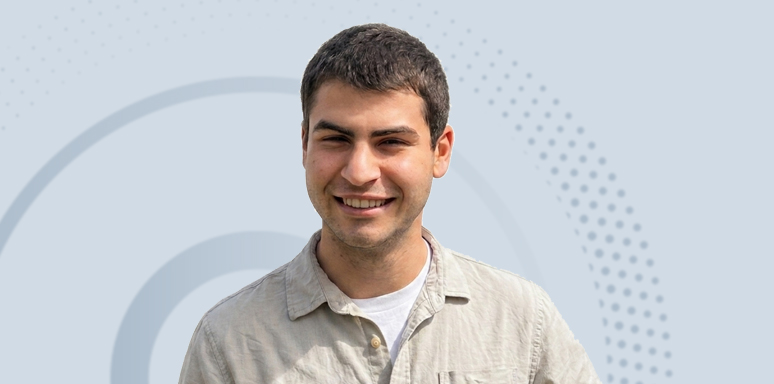
Rodriguez, a student at the Faculty of Engineering, was the lead author of a paper on interference mitigation in communication systems via deep learning. The paper was presented at the 2026 International Conference on Communications by his supervisor, Dr. Amir Weiss, and drew considerable interest
This year's annual flagship conference ICC 2026 of the communications community of the International Institute of Electrical Engineers IEEE, was held in Glasgow, Scotland. One of the speakers was Dr. Amir Weiss, who presented the paper "Learning to Separate RF Signals Under Uncertainty: Detect-Then-Separate vs. Unified Joint Models," whose lead author was Ariel Rodriguez, an undergraduate student of electrical engineering at the Faculty of Engineering at Bar-Ilan, who carried out his final project under Dr. Weiss. “This is the first paper from my research group published with an undergraduate student as lead author,” says Dr. Weiss
When you connect to the foundations, you have fun
Ariel, 23, from Petah Tikva, completed his undergraduate studies in electrical engineering, specializing in signal processing and communications. "I arrived at the Faculty of Engineering after completing 5 units of mathematics, 5 units of physics, and 10 units of software engineering in high school, and I wanted to study a profession that combines these subjects," he says. "I chose Bar-Ilan University after surveying the various universities in Israel, and I noticed that the responses from Bar-Ilan's and the Faculty of Engineering's admissions office were much faster and more caring than the rest of the institutions. When I talk to friends about Bar-Ilan, I tell them that the bureaucratic side of the university feels human, which positively affects the study experience."
He chose to specialize in the signal processing and communications tracks because he felt more connected to the mathematics taught there than in other tracks. "In my opinion, when you connect to the foundations of your specialization, solving technical exercises with long equations is not a miserable experience, and you enjoy reaching the interesting topics the specialization has to offer," he says. "In addition, I related to the concept of the specialization: information processing theory, its optimal utilization, and its transmission to another destination. In my opinion, this is a form of thinking that we all follow on a daily basis in interpersonal relationships or when learning a new subject – it's just that in engineering, it is realized through mathematical models, and executed by electricity, such as electromagnetic signals or the memory found in the processor."
"Being a lead author on an academic paper is a source of great pride"
Ariel carried out his final project under the guidance of Dr. Amir Weiss. "The project is an extension to prior research conducted by Dr. Amir Weiss on the possibilities of integrating deep learning into communications signal processing. Nowadays, almost every electrical device comes with an option for wireless communication that is usually on the same frequency band (like Wi-Fi), causing devices to interfere with one another. Dr. Weiss's research showed that there is great potential for improving the reception and quality of information in a crowded frequency band using a neural network that learns to separate a desired information signal from an interfering signal. However, a gap remained between the proof of concept and its implementation in real systems; in the original research, a neural network had to be educated on each distinct pair of desired signal and interference. My project investigated the first step of whether the learning process can be made more robust, meaning whether a single neural network is capable of identifying and separating two types of interferences from our desired signal with the same performance that two neural networks are capable of. To our delight, the answer is yes!"
When most of the research results began to yield positive empirical answers, Dr. Weiss suggested that Ariel be the lead author of the paper summarizing the topic. "Writing the paper was a very educational experience. The real challenge was finding a way to summarize so much information in just six pages, and examining what could be omitted and what had to stay so that readers would trust the research conclusion. In the process, I was exposed to things that you only see from an author's perspective, such as the importance of word choice and phrasing the concept, or the method of presenting the results. Dr. Weiss helped me, of course, and guided me throughout all stages of writing the paper."
"Being a lead author on an academic paper is a source of immense pride, especially when you're an undergraduate student, which is less common. My mother's family came from Ukraine; they are academics, and throughout my life she pushed me to invest in my studies. Therefore, this is like coming full circle, an opportunity to reap the fruits of the hard work and efforts I put into my studies, in school and then at the university."
"Now, how can we take it one step further?"
Regarding his supervisor, Dr. Weiss, Ariel shares that "working with him was a wonderful experience. Amir is an excellent supervisor. We met every other week or so to work on the project, and every time I presented him with the latest results, he said: 'Very nice, now how can we take it one step further?'. We both have high standards, and he always pushed me to keep putting in effort into the project, and later in the paper, while guiding me on what to focus on," he says. "On a personal level, Amir is a very caring person, and was considerate of me when I had personal or academic constraints that delayed progress on the project."
Dr. Weiss also speaks highly of Ariel. "Ariel was a wonderful student, a pleasure to work with. Industrious, smart, and thorough. Beyond that, the paper was written with an additional co-author from a university in Madrid, so I was able to show, indirectly, the high level of our undergraduate students in the Faculty of Engineering. The presentation at the conference was excellent, there was great interest from the audience, and there were many questions at the end of the lecture. I was very happy about that, but I was especially happy for Ariel, who knew how to translate his successful project into a beautiful paper."
Academic success has left Ariel wanting more. "The specialization of communications is a very broad world, and in an undergraduate degree, you learn the basics and do not manage to reach the deeper and more complex topics. I love the profession, and therefore hope in the coming year to return to the faculty for a graduate degree in this specialization."
Last Updated Date : 09/08/2026