
The Annual Hackathon of the "Digital Design Principles" Course
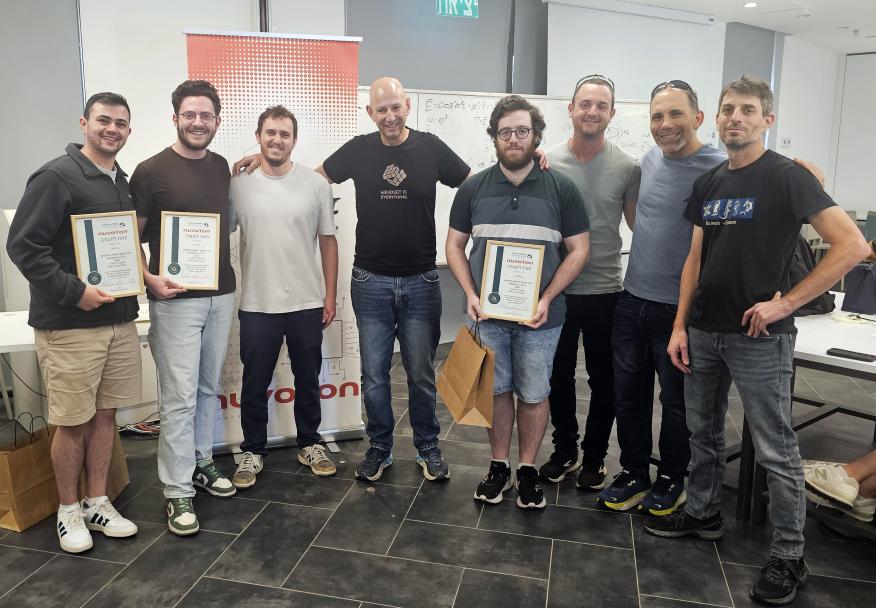
As part of the hackathon, the students of the course, led academically by Prof. Adam Teman, were asked this time to develop a system based on artificial intelligence for sign language recognition. The challenge was defined and led by Dr. Udi Kra
As every year, the "Digital Design Principles" course concluded with a challenging, creative, and enjoyable hackathon, held this time under the sponsorship of Nuvoton Technology Israel Ltd.
This year the hackathon focused on developing a system based on artificial intelligence for sign language recognition, with the aim of assisting the hard-of-hearing community. The system is implemented on a digital platform that combines software with hardware accelerators. The challenge combined the design of complex systems, artificial intelligence, hardware acceleration, and real-world social impact.
The course's academic supervisor is Prof. Adam Teman, and the hackathon challenge was defined and led by Dr. Udi Kra in addition, the course team includes the lecturer Yonatan Shoshan and the teaching assistants Eyal Yemini, David Shinenzon, Ze'ev Gastwirt, Eliyahu Levi, and Matan Nachum. The course received a teaching-creativity grant from the Learning and Teaching Division of Bar-Ilan University.
Efficiency, Performance, Innovation
As part of the hackathon, in which 28 teams took part, the students were required to develop a complete solution and demonstrate it on an FPGA component. The FPGA boards, which were used in the hackathon and also as part of the course's curriculum throughout the semester, were donated by Intel.
The systems developed were measured according to efficiency, performance, and level of innovation, with special emphasis on the judicious use of artificial intelligence tools as part of the development process.
The teams all successfully met the challenge and presented particularly impressive results, with an acceleration of the recognition process by three to four orders of magnitude compared to a software solution without hardware acceleration.
The hackathon's closing event included, in addition to the awards ceremony, two fascinating guest lectures: Dr. Noam Roknian, a doctoral student at the Faculty, shared his personal acquaintance with sign language in reality. Amichai Ben-David, a graduate of the Faculty and currently an employee of NVIDIA, presented from his experience as an expert in advanced methodologies for using artificial intelligence tools for hardware development.
And the Winners Are!
First place was split between two projects: the project of Amit Ron, who worked alone, and the project of Yuval Yalon and Gil Rozen.
Second place was won by the team of Rom Barak and Noam Malka.
Third place was awarded to the teams of Yoav Weiss & Ido Israeli, and Srinath CN & Daniel Dov.
Six additional teams received an honorable mention for exceptional achievements.
The winning teams demonstrated great determination, alongside a deep and creative understanding of the required optimization techniques, which led them to achieve a particularly high level of system performance through optimal use of the hardware resources for maximal parallelization of the computations, as well as through a significant improvement of the operating frequency by identifying and handling bottlenecks. All this, while making judicious and effective use of artificial intelligence tools for optimization purposes, alongside recognizing the limitations of the tools and making manual improvements that exceed their capabilities.
Congratulations to the winners! See you at next year's hackathon!
Last Updated Date : 30/07/2026