


News
-
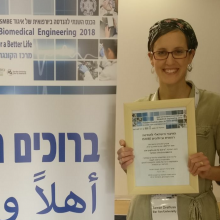
Trailblazing Clinical Technology
In February 2018, the Israeli Society for Medical and Biological Engineering (ISMBE) held its annual conference, during which excelling doctoral candidates from all universities in Israel were awarded for groundbreaking discoveries. This year, six awards were handed out, one of which to Tamar Dreifuss, of Prof. Rachela Popovtzer's lab at BIU’s Alexander Kofkin Faculty of Engineering.
-
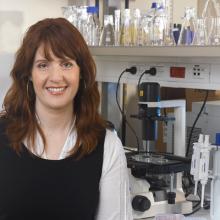
Engineering Is All About Girl Power
Prof. Rachela Popovtzer, Director of the Bioengineering study track at the Faculty of Engineering, knows exactly how to prompt women to choose a career in engineering – and she has no problem enrolling her students to helpProf. Rachela Popovtzer, Director of the Bioengineering study track at the Faculty of Engineering, knows exactly how to prompt women to opt for a career in engineering – and she has no problem enrolling her students to help
-
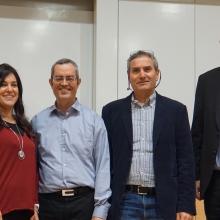
Influential Nano Role
In December 2017 Prof. Dror Fixler of the Faculty of Engineering began his tenure as Director of the Bar-Ilan Institute for Nanotechnology and Advanced Materials. In his inaugural speech, Prof. Fixler presented his elaborate vision of the Institute.
-
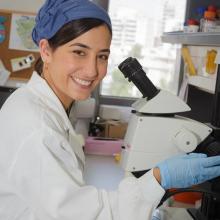
An Award Winning Mother, Scientist, and Student
Michal Marcus, a doctoral candidate at the Neuro Engineering Research lab led by Prof. Orit Shefi has won the Rappaport Prize for Excelling Students of Biomedical Engineering.
-

Prof. Sharon Gannot wins the Rector's Award for Scientific Innovation for 2018
Prof. Sharon Gannot, Head of the Speech and Signal Processing laboratories and the Signal Processing Track at the Faculty of Engineering, is one of a dozen leading researchers to win this year's Rector's Award for Scientific innovation, along with a 5,000NIS research grant. Prof. Gannot was awarded for his innovative scientific achievements this past year.
-
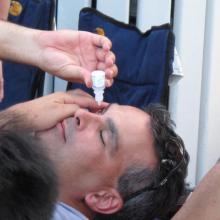
Prof. Zeev Zalevksy helps develop nano-eye drops that can improve both nearsightedness and farsightedness
Prof. Zeev Zalevksy, along with Prof. Jean Paul Lellouche and Research Associate, Dr. David Smadja, of BIU's Institute for Nanotechnology and Advanced Materials, along with experts from Shaare Zedek Medical Center, develop nano-eye drops that can improve both nearsightedness and farsightedness.
-
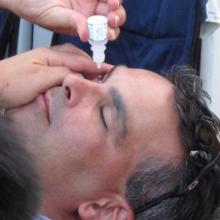
BIU researchers invent revolutionary eye drops that could replace eyeglasses
Prof. Zeev Zalevsky of the Kofkin Faculty of Engineering, Prof. Jean Paul Lellouche, of the Department of Chemistry, and Dr. David Smadja, a research associate at BINA and Director of Research and Innovation at Shaare Zedek Medical Center developed eye-drops that have been found to repair the corneas and improve short and long sightedness. The nanoparticle solution called as “nanodrops” was successfully used on pigs’ corneas.
-

Fulbright Scholarship to Engineering Postdoc Researcher
Congratulations to Dr. Rinat Meir, a postdoctoral researcher working under Prof. Rachela Popovtzer, who has won the prestigious Fulbright Scholarship for postdoctoral researchers for 2018/9.
-
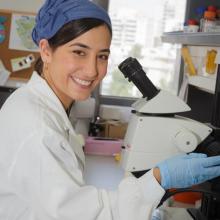
Rappaport Prize to PhD Candidate in Prof. Shefi's Lab
Michal Marcus, a doctoral candidate at the Neuro Engineering Research lab led by Prof. Orit Shefi has won the Rappaport Prize for Excelling Students of Biomedical Engineering.
Michal (30), a married mother of 3, won the prestigious prize for her development of methods to lead medication directly to infected areas of the body (rather than flowing freely in the bloodstream). The project includes binding the drugs to magnetic nano carriers and using the magnets to lead the drug to the infected area.
Michal was informed of her win by Nobel Laureate Prof. Ciechanover, Aaron, who heads the Baruch and Ruth Rappopot Foundation's awards committee. -

Prof. Alex Fish's SoC lab in industrial collaboration with FlexLogix Technologies
Flex Logix Technologies today announced that its embedded FPGA technology will be used by a consortium of Israeli semiconductor and systems companies including Mellanox, SatixFy, DSP Group and Autotalks under a license with Bar Ilan's SoC Lab, headed by Prof. Alex Fish (Engineering) which is part of the HiPer Consortium. The consortium will leverage Flex Logix's platform to design an architecture and technology 16nm evaluation chip and then use Bar-Ilan University's SoC Lab to prove out and implement a chip that can be used by each member company, reports Prnewswire, saying Bar-Ilan is one of the top technology Universities in Israel.
-
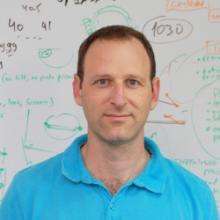
Dr. Ofer Limon- An Alumnus Success Story
Optometric Examinations Through a Novel Application
6over6, headed by Dr. Ofer Limon - a graduate of all three Faculty of Engineering degrees - is based on a breakthrough technology which performs full optometric testing by means of a software application alone.
"We developed the technology thanks to a different kind of observation of optics and physics than what has been accepted up till now, and out of a deep understanding of optics and years of experience working alongside optometrists," he said. "Our technology enables people to perform the same optometric measurements on their mobile phones, at a time convenient to them, and without leaving their homes, and to use e-commerce platforms to purchase glasses for distance vision”
-

Faculty Researchers Use Gold to Find Cancer Treatments
The Times of Israel reports that a team of researchers is using gold to develop cancer treatments. The team includes Prof. Rachela Popovtzer of BIU's Faculty of Engineering and Institute of Nanotechnology and Advanced Materials, as well as scientists from Tel Aviv University, and the Institute of Oncology, Davidoff Cancer Center at Rabin Medical Center. Their findings were first published in the journal Nanoscale in January 2016.
-
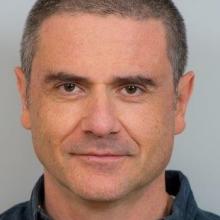
Prof. Zeev Zalevsky Nominated Fellow of the US National Academy of Inventors
Congratulations to Prof. Zeev Zalevsky, Head of the Electro-Optics study program at the Faculty of Engineering and Director of the Nano Photonics Center at the Institute of Nanotechnology and Advanced Materials (BINA), for being honored with the esteemed distinction of becoming a Fellow of the American National Academy on Inventors.
-

Taubenblatt Prize Awarded To Prof. Rachela Popovtzer
Prof. Rachela Popovtzer, of the Faculty of Engineering and Institute for Nanotechnology and Advanced Materials (BINA), is the recipient of the Leon and Maria Taubenblatt Prize for Excellence in Medical Research for 2017. Prof. Popovtzer earned the award for her research on Theranostic Nanoparticles for Future Personalized Medicine.
-

Engineering students help develop a revolutionary method for diagnosing multiple sclerosis
Dr. Maya Aviv, Dr. Adi Vagerhoff and Dr. Eyal Cohen, all former students (now alumni) at Prof. Zeev Zalevsky's laboratory at the Faculty of Engineering, collaborated with with two Holon Institue of Technology students, and successfully developed a method to diagnose multiple sclerosis in two to three minutes from imaging, with a certainty close to 100%. They have developed an algorithm that can scan the hundreds of images produced by MRI in two or three minutes and possibly detect cells in the nervous system that are affected.
(Orignial article in French)