

Academia and Intelligence: The Faculty of Engineering's Annual Retreat
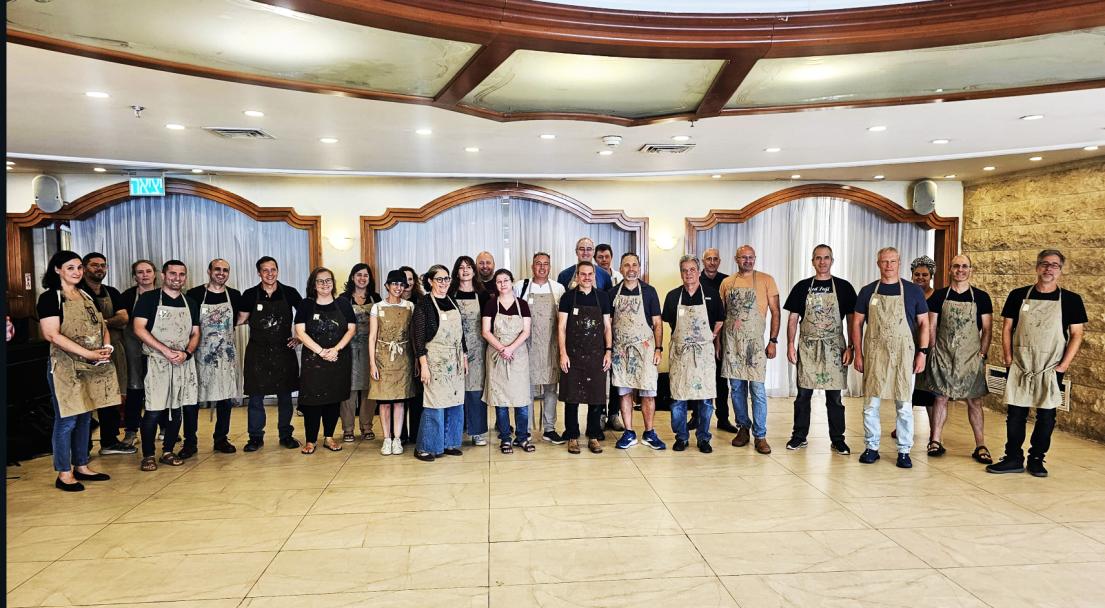
During the two-day event in Jerusalem, faculty members engaged in questions surrounding the integration of AI into teaching and research, stimulating and motivating students, and how to fit into the industry in the AI age
The Faculty of Engineering's annual retreat for 2026 was held in early September in Jerusalem. The main item on the agenda was refining and improving the faculty's study programs. "The goal was to nurture a brainstorming session among faculty members about the challenges facing the faculty in the AI era. During the retreat, we took it upon ourselves to characterize the challenge and to offer a response, both at the course level and at the level of an adaptive faculty-wide curriculum," explains Dr. Hamootal Duadi of the faculty's Teaching Committee, coordinator of the 360 program and organizer of the retreat.
The Faculty of Engineering was selected to take part in the Planning and Budgeting Committee's "Academia 360" program, which aims to adapt undergraduate study programs to the dynamic technological world, with an emphasis on the optimal integration of graduates into industry and the community. "Faculty members are engaged with these issues, and during the retreat many of them shared their ideas on what they would like to do and to implement that. The faculty is now formulating an action plan based on their suggestions," says Hamootal.
Teaching in an era of all-access knowledge
The retreat's first session, Teaching and Engineering – Looking in the Mirror, opened with two short lectures on the state of teaching at other academic institutions. The first was given by Prof. Uri Nevo of Tel Aviv University, and the second by Noam Feldman, a Faculty of Engineering alumnus currently studying at the Faculty of Medicine at the Weizmann Institute. These were followed by a round-table session. "Faculty members from a range of programs and tracks sat together to discuss and share creative ideas," says Hamootal. "Each table was given a challenge currently facing the Faculty of Engineering, and together they raised ideas and viable solutions."
Participants discussed issues such as teaching skills in an era when knowledge is accessible to everyone; teaching software in the era of vibe coding (programming by chat); launching project-based learning in courses and teaching laboratories; how to make lab exercises meaningful in the AI era; changing the students' state of mind; how to make academic studies a meaningful experience on a personal, social, and emotional level; and how to help students prepare for the job market.
This is how AI will help with research
The retreat's second session, Human Scientist in the AI Loop – Symbiotic Scientific Thinking, was moderated by Prof. Ayelet Segal, academic director of the clusters in Bar-Ilan's Division of Structured Programs and Certificate Studies, head of the AI & I lab, and AI advisor to the NMR Forum. "Among other things, the session dealt with harnessing AI for research – not writing papers with ChatGPT, but real in-depth work. Ayelet presented highly innovative approaches and ideas. It was very interesting and eye-opening," says Hamootal.
Every student is a startup
The third session also hosted two lecturers. Prof. Yaniv Fox of Bar-Ilan's Faculty of Education spoke about Integrating Artificial Intelligence into Teaching: Practical Experience and Institutional Policy. Prof. Fox gave practical examples of integrating AI into learning, such as assignment assessment: "He told us, for instance, that instead of asking students to write a paper that can be easily produced by a chatbot, he asks them to record a video of themselves, in which they are not allowed to read off the page. The very fact that they have to learn it by heart makes them go back and review the material, and also teaches them presentation skills." Another example Prof. Fox gave was a simulated 3D engine model built for him by an AI tool, where he can take the model apart and see its components and the physical forces acting on it.
Prof. Haim Zvi Dotan, head of the Innovation Program at HIT, gave a lecture titled Multidisciplinary Engineering: Every Student Is a Start-Up. He spoke about how to instill passion and enthusiasm in students, and how to train them to produce a project in next to no time. "Prof. Dotan also shared from his personal experience with innovative projects he initiated. He wanted to build the world's first glass bridge. At the time, that dream was considered impossible, and he shared with us how he made it come true, at low cost and in less time than expected."
What's hot in research?
The fourth and final session of the conference, moderated by Prof. Alex Fish, featured presentations by Prof. Freddy Gabbay of the Institute of Electrical Engineering and Applied Physics at the Hebrew University, and Ella Shulman of RedHat. They each shared their insights on what is interesting and important in research, academia, and industry, and how focus has shifted in the age of artificial intelligence. "In this era of the Fifth Industrial Revolution, imparting technological knowledge is not enough," Hamootal concludes. "The faculty's role is to train the next generation of engineers so that they can lead alongside AI, while developing critical thinking, creativity, and the ability to work synergistically with autonomous systems."
Last Updated Date : 27/09/2026